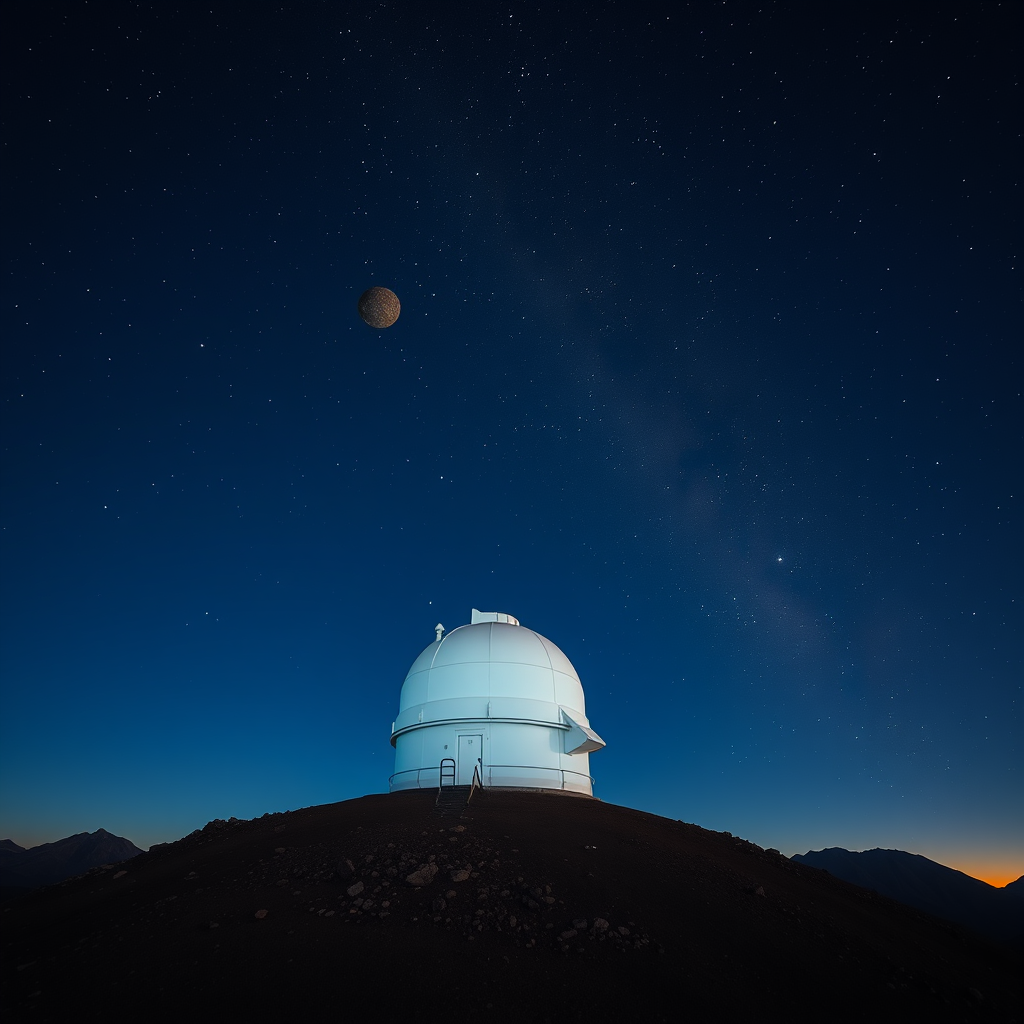
The arrival of the Vera C. Rubin Observatory marks a transformative leap in our ability to monitor the heavens. Equipped with a staggering 3.2-gigapixel camera, this technological marvel has begun capturing the elusive movement of the solar system’s fastest-spinning asteroids. These cosmic speed demons, rotating in mere seconds, offer vital clues about the formation and stability of near-Earth objects.
A Visionary Window Into the Deep Sky
The Cosmic Whirl: Vera C. Rubin Observatory Unveils the Fastest Spinning Asteroids
The Vera C. Rubin Observatory represents a paradigm shift in astronomical observation. Its 3.2-gigapixel camera, a behemoth comparable in size to a small car, is strategically positioned atop the Cerro Pachón ridge in Chile’s Andes Mountains. This observatory’s main objective is the ambitious ten-year Legacy Survey of Space and Time (LSST), promising to revolutionize our understanding of the cosmos. Unlike conventional narrow-field telescopes that focus on specific celestial targets, the Rubin Observatory operates as a wide-angle “movie camera” for the universe. It systematically photographs the entire visible sky every few nights, meticulously recording minute changes in the brightness and position of celestial objects. This capability is crucial for detecting fast-moving objects like asteroids, providing unprecedented data for studying their origins and potential impact risks. The observatory’s advanced technology allows for the discovery of previously unseen phenomena, including the solar system’s fastest-spinning asteroids, which complete rotations in mere seconds, offering vital clues about the formation and stability of near-Earth objects.
The Record-Breaking Rotation of Space Debris
The Cosmic Whirl: Vera C. Rubin Observatory Unveils the Fastest Spinning Asteroids
The Vera C. Rubin Observatory has recently unveiled the existence of the solar system’s fastest-spinning asteroids, cosmic bodies that defy expectations by completing a full rotation in under 10 seconds. These celestial speedsters are not merely curiosities; their rapid spin holds vital clues to the formation and evolution of near-Earth objects. The key to their incredible speed lies in a phenomenon known as the YORP effect. This subtle yet powerful mechanism involves the anisotropic emission of thermal radiation from an asteroid’s surface. As sunlight warms one side of the asteroid, it re-emits this energy as infrared radiation. If this emission is not uniform, it creates a tiny thrust that, over eons, gradually increases the asteroid’s angular velocity. The discovery of these ultra-fast spinners is groundbreaking because they challenge our understanding of asteroid structural integrity. Objects spinning this rapidly would typically be expected to fly apart due to immense centrifugal forces. Yet, these asteroids remain intact, suggesting they possess a solid, monolithic structure rather than being loosely aggregated rubble piles. This implies a more complex and varied internal composition for asteroids than previously assumed, opening new avenues for research into planetary formation and material science in extreme conditions.
Guarding the Planet Through Precision Tracking
The tracking of fast-spinning asteroids by the Vera Rubin Observatory offers significant practical and scientific applications, particularly in the realms of planetary defense and resource mapping. Understanding the rotation rate of these celestial bodies is paramount, as it provides crucial insights into their internal density and mineral composition. Asteroids that spin at extreme speeds are often less consolidated, and their rotation rate can indicate whether they are solid bodies or loosely bound “rubble piles.” This knowledge is vital for planetary defense initiatives; the Rubin Observatory’s enhanced capability to detect faint, rapidly moving objects acts as an unprecedented early warning system for near-Earth objects (NEOs). By identifying these potentially hazardous bodies early, scientists can better assess the risk of asteroid impacts. Furthermore, this data is essential for the engineering requirements of potential deflection missions, offering valuable information akin to that gathered during the DART mission, to safeguard our planet. The detailed data from Rubin Observatory also aids in mapping potential asteroid resources, identifying bodies rich in valuable minerals that could be exploited in the future.
Mapping the Millions in a New Cosmic Catalog
The Vera C. Rubin Observatory, with its unprecedented 3.2-gigapixel camera, is generating a deluge of astronomical data, poised to revolutionize our understanding of the cosmos. Projections indicate the Large Synoptic Survey Telescope (LSST), housed within the observatory, will catalog an astonishing 20 billion galaxies and 17 billion stars. This massive influx of information is expected to increase the known count of solar system objects by a factor of ten, ushering in a digital revolution for astronomy. Such a wealth of data necessitates sophisticated big data analysis. Advanced algorithms and artificial intelligence will be crucial in sifting through this cosmic ocean, identifying rare celestial phenomena such as interstellar visitors and, pertinent to our ongoing discussion, record-breaking fast-rotating asteroids. In a move that democratizes scientific exploration, all this valuable information will be openly shared, empowering researchers and citizen scientists globally to participate in the thrill of space discovery.
Conclusions
The Rubin Observatory has officially opened a new frontier in space exploration, moving beyond static images to a dynamic, real-time map of our neighborhood. By identifying the fastest-spinning asteroids, scientists can better prepare for potential impacts and unlock the history of our solar system. This era of high-speed discovery promises to reshape our understanding of the cosmic dance forever.